Scientific Objectifs
Meteorology of Mars
-
Optical depth of dust
-
Frequency, altitude, optical depth of cloud
Scientific Principles
The scientific principle of ODS has been detailed in Tran et al. 2005. Dust opacity is derived from a relative measurement, ratio of total (direct and scattered) sunlight when the Sun passes by field of view (FOV) during some period of daytime over scattered light when Sun is not viewed for the rest of daytime. It is thus independent of instrument calibration, aging and temperature drift, as well as dust deposition at the entrance (Landis and Jenkins, 2000).
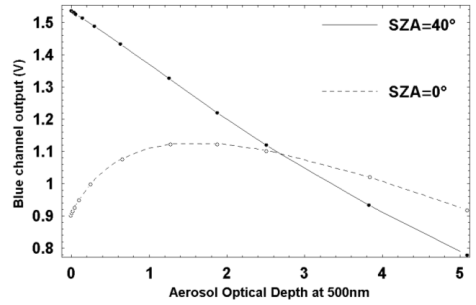 Figure 1. Simulated ODS signal at one channel shows dependence of total (direct and scattered) light (SZA = 40°) and scattered light (SZA = 0 °) on optical depth of dust layer at the channel's spectral band pass (wavelength near 370nm).
High altitude clouds are detected by looking at the relative evolution of scattered light at two wavelengths, blue and red, at zenith during twilight following a color index technique (Bell et al., 1996) very similar to that used routinely on Earth for the detection of polar stratospheric clouds (Sarkissian et al., 1994).
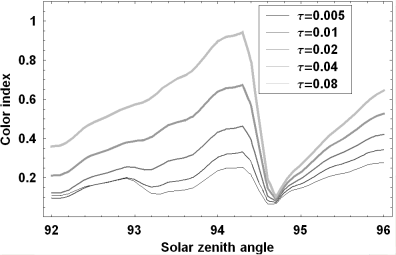 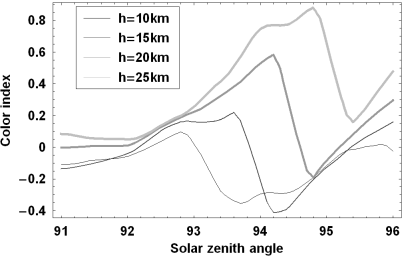 Figure 2. Simulation of difference between red and blue channels' signals (color index) shows evolution with SZA at terrestrial twilight as optical depth (on the left) and altitude (on the right) of high cirrus vary.
For the measurement of dust, the instrument composes of an optical head focalizing the sky within FOV from 25° to 50° onto a photodiode and a logarithmic amplifier that convert photodiode current to voltage output. For the detection of cloud, ODS can have two channels, one detecting blue sunlight and the other receive red sunlight. There are also options for water vapor and ozone detections, which require additional channels observing at near infrared and UV respectively.
Algorithm of data treatement
Validations
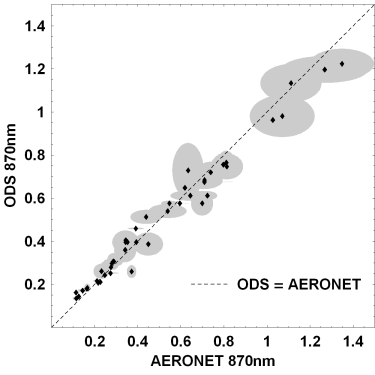 Figure 2. Correlation between ODS and AERONET (data level 1.0) daily average optical depth at 870nm, during two dry seasons (November 2004 to February 2005 and November 2005 to February 2006), at Ouagadougou, Burkina Faso. Shown are selected ODS and AERONET results with relative uncertainty less than 20%.
Publications
-
Tran T.T., Pommereau J.-P., Rannou P. and Maria J.-L., 2005, Scientific aspects of the optical depth sensor, Advances in Space Research, 36, 2182-2186. doi:10.1016/j.asr.2005.08.021
-
Tran T.T., Optical Depth Sensor for the measurement of dust and clouds in the atmosphere of Mars. Radiative transfer simulations and validation on Earth, Ph.D. Thesis, PDF format
-
Tran T.T., Rannou P., Pommereau J.-P. et al., The Optical Depth Sensor, Notes Du Pole de Planetologie, ISSN 1768-0042, PDF format
-
Tran T.T., Presentation of ODS, Presentation at the Defense of Thesis, PowerPoint (version 10.0) format, in French

|
