General descriptions
Components:
-
Optical head : a system of 2 parabolic mirrors, focalizing the sky onton 1 photodiode, using 1 central mask to:
-
Obtain alternating FOV 25° - 50 °
-
Reduce specular scattering of dust cover on optical system
-
Electronics : 8-decade logarithmic amplification, converting photodiode current to output voltage, temperature compensated, to work with:
-
Both direct solar intensity and twilight intensity
-
Martian temperature variation from -120°C to 50°C
NETLANDER specifications
General specifications:
-
Number of channel : 2
-
Mass : 90g (25g×2 optical head + 20g×2 electronics, cables not included)
-
Comsomation : 30mW
-
Data rate : 2kb/day
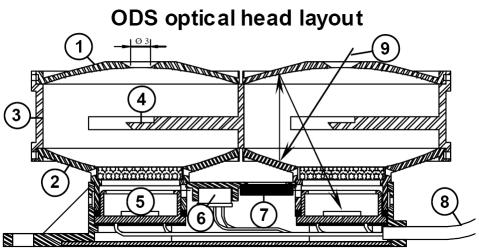 Figure 1. Mechanical and optical layout of optical head of ODS in NETLANDER version of two channels: (1) upper parabolic mirror and entrance pupil, (2) lower parabolic mirror, (3) black wall, (4) black central mask, (5) silicon photodiode, (6) temperature sensor, (7) micro-porous pressure equalizer, (8) coaxial cables, (9) sunlight path.
Photodiode:
Electronics:
-
Typical transfer function (CSVdata)
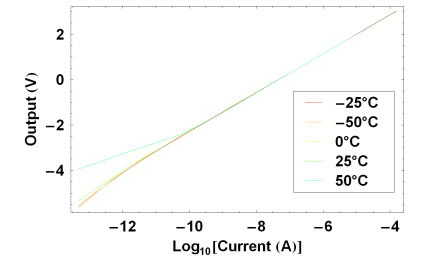 Figure 2. Typical electronics transfer function, from photodiode current (A) to output voltage (V), with varying temperature (from -50°C to 50°C). Between range of -3V to 3V, the output is nearly linearly dependent on logarithm of current and independent with temperature; except for temperature as high as 50°C and low current (observation at night, rarely with temperature as high).
-
Typical inversed transfer function (CSVdata)
References
-
Maria, J.-L., Tran, T.T., Pommereau, J. P. et al., Technical aspects of the optical depth sensor, Advances in Space Research, accepted.

|
